
When big siblings “help” too much, the child who is always last stops trying. Here’s what I saw in one Pre-Kindy room, and what changed it.
The question at the door
It was one of those late afternoons when the room smells like paint and chocolate biscuits, and the light comes in low across the floor.
S’s mum came in a little earlier than usual. She stood by the sign-out sheet for a moment, then asked the question she had clearly been carrying around all day.
“Can I ask you something? How is he in the room? Because at home… if he can’t already do it, he won’t touch it. I say, ‘You can do it.’ I say, ‘Everybody makes mistakes at the start, that’s normal.’ And he just screams, I can’t, and runs off. Every time. Why is he like this?”
I had to work quite hard to keep my face neutral.
Because the child she was describing — the one who screams I can’t and runs — I had never met him.
The S in our room is the one who spots a younger friend wrestling with the lid of the block container and goes over without being asked. He is first up when I say, “Who wants to help me carry this?” He tries the zip. He gets the zip wrong. He tries the zip again. When we introduced tongs at the fruit table, he was the child who stood there, tongue out in concentration, chasing one slippery piece of pear across the plate for a full minute rather than let anyone take over.
Same child. Same week. Two completely different people.
So which one is the real S?
Both of them. That’s the uncomfortable part. Behaviour is almost never a fixed personality trait sitting inside a child. It is a conversation between a child and the room he’s standing in. If a child is capable in one room and helpless in another, the honest next question is not what’s wrong with him — it’s what’s different about the rooms.
So I asked about home.
Two rooms, two scripts
Home: S is the youngest of four. He has an older brother and two older sisters. They adore him. And this is the important bit — they are kind. Nobody in that house is being mean to him. They are simply older, faster and very competent, and they love him, and love in a busy household usually looks like speed.
Picture the morning. S starts hunting for the armhole of his jumper. It takes him a while; two-year-old hands and jumper sleeves have a complicated relationship. Somewhere around second four, a sibling — who genuinely just wants to be helpful, and who is also very good at jumpers — reaches over and does it for him.
He never finishes a jumper. He has never once in his life finished a jumper.
Multiply that by shoes, cups, seatbelts, drink bottles, doors, taps, the pencil that rolled under the couch. Multiply it by two thousand mornings.
The room: the children around him are his own age or younger. Some have just started. Nobody at that fruit table is faster than S. Nobody swoops. When S goes after a piece of pear with the tongs, there is a small, uninterrupted space around him in which the pear is his problem — and, when he gets it, his win.
That’s it. That’s the whole difference. Not confidence, not temperament, not “he’s spoiled.” Opportunity.
Watching is learning, but doing is becoming
There’s a reason this pattern shows up so consistently in youngest children with much older siblings, and Albert Bandura described the mechanism decades ago.
Bandura’s point was that children learn enormous amounts by watching other people — far more, and far faster, than we can teach them directly. S has been watching skilled jumper-users at close range his entire life. He has an outstanding mental model of how a jumper works.
But Bandura also drew a line that I think about constantly in my room: acquiring a behaviour and performing it are two different things. You can learn something completely by observation and still never do it — because performance needs an opportunity, and it needs some belief that the attempt will go well.
S has the observation. He has never been given the opportunity. And so he has never built the belief.
There’s a second piece, and I think it’s the sharper one. Bandura talked about vicarious reinforcement: children are shaped not only by praise they receive, but by praise they watch other people receive. So think about where the praise lands in that house. Thank you for helping your little brother. You’re so good with him. Every single time, the warm feeling flows to the person doing the doing. And S is never the person doing the doing.
Over three years, a small child sitting in that seat learns two things very well:
- The applause happens over there.
- The distance between me and a competent person is enormous.
So when his mum says you can do it, everyone makes mistakes at first — she is being a lovely parent, and she is also asking him to walk straight into the one comparison he has lost every day of his life. Screaming I can’t and running is not laziness or stubbornness. It is a very sensible child protecting himself from a competition he has never once won.
He isn’t refusing because he can’t. He’s refusing because being slow in that room has always meant being replaced.
Watching is learning, but doing is becoming.
What we did in the room
We didn’t run a program. We changed his position in the group, in four fairly ordinary ways.
1. We gave him a job with a job title. Not “would you like to help” — an actual named role, announced to the group. S is our mat helper today. S is leading the line. Handing out cups, carrying the basket, choosing the pack-away song. Small jobs, but public ones, where the group has to wait for him to finish. Waiting for S is the point of the exercise.
2. We let him be the more capable one. He sat with younger children at the fruit table and showed them the tongs. And here I coached the helping, because two-year-olds help exactly like big siblings do — by grabbing. So we practised: show it, wait, hands down. He learned what it feels like to be the model instead of the audience. He also, I think, learned what it costs to be helped too fast, which is not nothing.
3. We made “I can’t do it” an ordinary sentence. Flexible thinking is a skill, and it is teachable. In our room, adults say their mistakes out loud — oh no, I’ve poured too much, look at that, I’ll try again. We add yet to everything. And we describe the effort rather than the result: you kept turning it around until it fit rather than good boy, you did it. Children who only get praised for finished results learn to attempt only the things they’re already sure of. That is precisely the trap S was already in.
4. We sent him visiting. Every so often he spent a short stretch in the older room. Being the youngest again — but by choice, for twenty minutes, then home to a room where he’s the capable one. He came back with things to try. Watching is powerful; it just can’t be the only thing on the menu.
None of this was fast. For the first fortnight he’d start a job, then hand it back to me halfway with a look that said you finish it. I’d put it back down between us and find something else to do with my hands.
What we asked home to try
The hardest part of this conversation is that there is no villain. Three older siblings doing something loving is not a behaviour problem. So none of these are “stop helping him” — that lands on a nine-year-old as stop being good, and they’ll be hurt, and they’ll do it anyway.
Give the older ones a harder job instead: the waiting job. Waiting is a skill, and it can be the thing they’re praised for. I need someone who can count to ten in their head while he does it. That’s a big-kid job — it’s harder than helping. Now the applause is available to them for holding back, and they can still be excellent at something.
Pick one thing a day that is his, start to finish. Choose it deliberately: small, predictable, and not urgent. Not the coat during the school run. The dog’s water bowl. His own placemat. Buttering his own toast, badly.
Make him the teacher once a week. He shows a sibling — or a parent — how to do something. Anything. The teaching seat is where vicarious reinforcement finally points at him.
Praise the attempt out loud, in front of the others. Look how long he kept trying with that shoe. You’re not just talking to him. You’re re-teaching the whole room where the warm feeling lives.
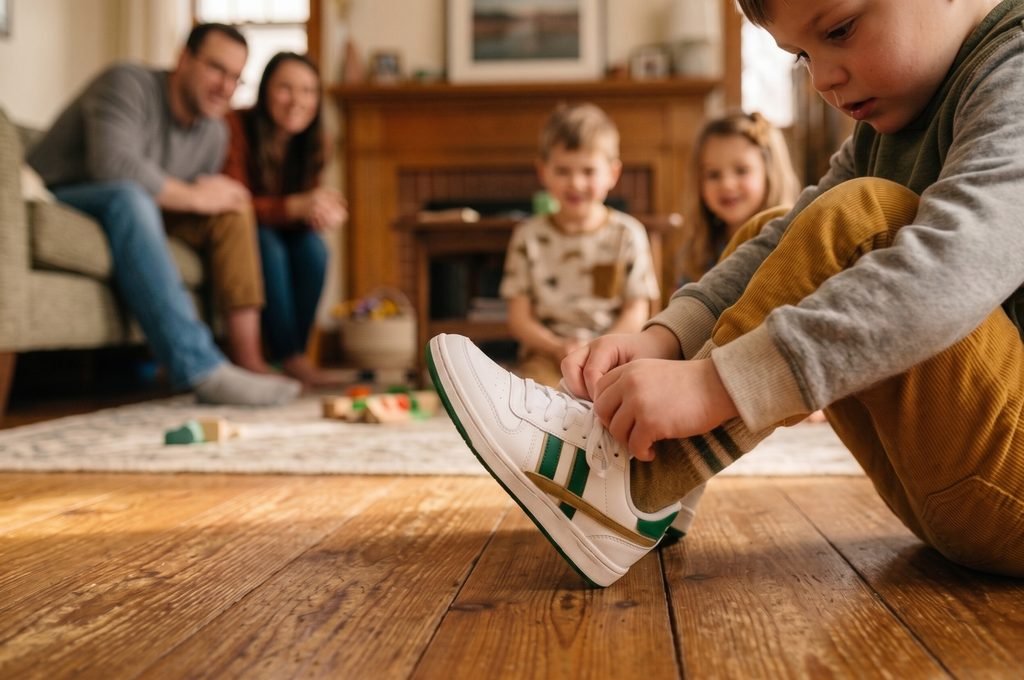
Let the mistake stand. Shoes on the wrong feet, out the door, wrong feet. The rescue can wait ten seconds. In those ten seconds is where “I’m the kind of person who can” gets built.
Where it landed
A few weeks later his mum came in grinning, holding a photo.
He’d put his own shoes on at home. Wrong feet. And then — this is the part she wanted me to know — he’d stood up and announced it to the entire house.
Wrong feet, and he announced it. That’s the whole thing. Not the shoes. The announcing.
He didn’t need to be taught. He’d been in the front row of that lesson for three years. He needed a turn.
References
Australian Government Department of Education. (2022). Belonging, being and becoming: The early years learning framework for Australia (V2.0). Australian Government Department of Education for the Ministerial Council.
Bandura, A. (1977). Social learning theory. Prentice-Hall.
Details in this post have been changed
and combined to protect the privacy of the child and family involved.
Pingback: Why: Know Your Reason -