
How one book, one cosy corner, and two months of patience gave a two-year-old his words
There is a sound you learn to recognise in a Pre-Kindy room.
Not the crying. Crying comes afterwards. It’s the half-second of silence before the crying — the moment when a two-year-old’s whole body goes still, and you are already moving across the room, and you are already too late.
S was two. S was a biter.
I want to be careful with that sentence, because it isn’t fair. S was a lot of things. He was the first one at the window when it rained. He laughed with his whole stomach. He carried a blue truck around like it was a pet. But when he was angry — when something was taken, when someone came too close, when the feeling arrived faster than he could hold it — he bit.
And he didn’t bite someone. He bit whoever was nearest. There was no target, no grudge, no pattern we could map. Just a feeling with nowhere to go and a body that solved the problem the only way it knew how.
Everything we were supposed to do
We did all of it.
We shadowed him. We got down to his eye level. We used short, consistent language — “Teeth are not for biting. Biting hurts.” We named feelings for him: “You are angry. You wanted the truck.” We redirected. We offered a teether. We tracked times and triggers in case there was a hidden rhythm we were missing.
We talked with his parents, and his parents were wonderful — worried, willing, completely on board. They used the same words at home. They didn’t get defensive. They asked us what else they could do.
And nothing changed.
Not a little. Nothing. Weeks of consistency between home and the centre, and S kept biting, and every day I wrote another incident record, and every day I walked past a parent at the door hoping today wasn’t the day I had to have that conversation again.
That’s the part nobody writes about. Not the strategy — the stretch of time where the strategy isn’t working and you have to decide whether to keep going.
A different question
Somewhere in that stretch, I stopped asking the question I had been asking.
I had been asking: how do we get S to stop biting?
I started asking: what does S love?
It sounds small. It wasn’t. The first question treats a child as a problem to be closed. The second treats him as a person to be met. And I only thought to ask it because I couldn’t stand asking the first one anymore.
So I watched him. Not for triggers — for joy.
And here is what I found: S loved the cosy corner. He would take himself there, several times a day, and sit with a book. He had very few words at that point — a handful, mostly nouns — but he read. He read the way pre-verbal children read, which is to say properly: with his eyes all over the pictures, turning back three pages to look again at the one he liked, pointing at a face, waiting for you to say the name of the thing.
Books weren’t a strategy for S. Books were his language.
So — alright. If that’s the door, we go in through the door.
Reading about it, on purpose
We chose a picture book about biting and we read it with him. Not once, as an intervention. Over and over, as a pleasure.
We read it slowly, page by page. We stopped on the faces. “Look at him. How is he feeling? His mouth is like this. His eyebrows are down.” We asked what else the character could have done, and offered ideas out loud when S couldn’t. We acted the pages out with the small figures. We drew the “before” moment — the wanting, the reaching — and talked about what it feels like in your body.
Then we widened it. We brought in books about feelings generally: angry, sad, disappointed, frustrated, that specific two-year-old rage that has no name yet. We practised the words to use when the feeling arrives. “Stop.” “That’s mine.” “I don’t like it.” Three-word sentences, because three words was where S was.
There’s a line of thinking behind this that I only articulated to myself later: for toddlers, biting is very often communication that has run out of other options — a child with strong feelings and not enough language, doing the only thing available (Kinnell, 2008). Which means “stop biting” was never really the goal. Giving him something to say instead was the goal.
And then we waited. Which is the hard part.
Two months
Two months.
The biting reduced — a little. Enough to notice, not enough to celebrate. It was still there. There were still records to write and still conversations at the door.
I’ll be honest about week six: I wondered whether the books were actually doing anything, or whether they just made me feel like I was doing something. That doubt is part of the job and I think we should say so more often.
The morning it happened
Then one ordinary morning, S was in the block area.
Another child reached for his tower.
And S — who bit, who had bitten on Monday — looked up and said:
“Don’t. I don’t like it.”
And the other child stopped. Pulled their hand back. Moved on.
I don’t think I have ever been so still in a classroom. Two educators looked at each other across the room with the exact same face.
We went to him straight away. “You did it! That’s how you say it! You told him with your words!”
S went completely shy — hid his chin in his shoulder, couldn’t look at us. But he was glowing. You could see it. He was proud of himself, and he knew what he had done, and he had no idea what to do with being seen doing it.
What was happening at home
I can’t take this one. Not most of it.
Behind those two months, S’s parents were doing something I still think about.
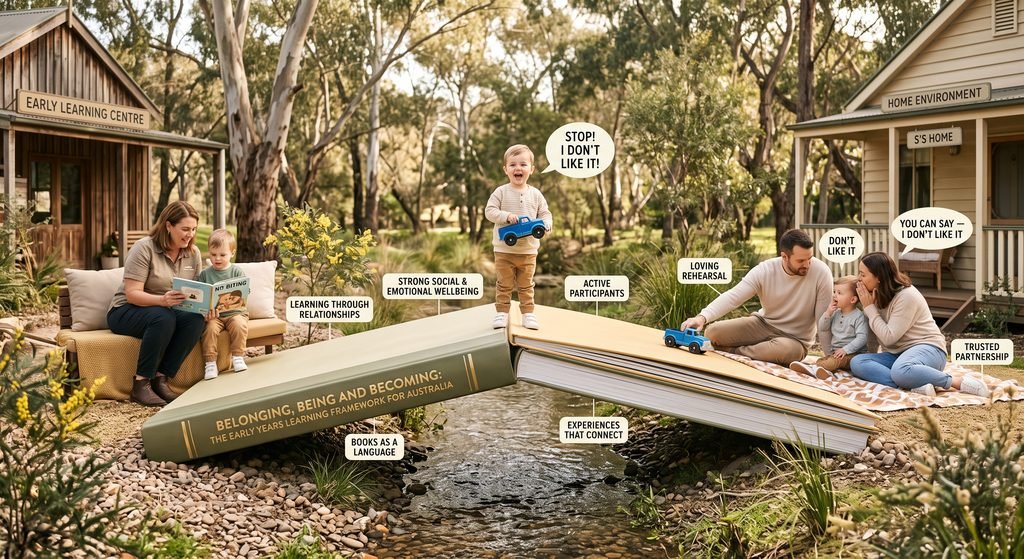
Every day at home, they staged it. Dad played the friend: he would pick up S’s water bottle “by mistake”. He would touch the puzzle S was working on. He would reach for the toy S was holding. Little manufactured moments of exactly the frustration that undid him at the centre.
And Mum sat beside S and coached. Quietly, right at his shoulder: “You can say — don’t touch it. Say: I don’t like it.”
Every single day. Not a worksheet, not a reward chart. Rehearsal, with people he trusted, in the only place safe enough to practise falling over.
So when the real moment came in the block area, it wasn’t the first time S had met it. It was maybe the fiftieth. He had the line ready.
Why it worked
When I look back at it now, I think two things carried it, and neither was the book by itself.
The child’s interest was the doorway. We didn’t pick books because books are good. We picked books because S loved books. The same content delivered through a medium he didn’t care about would have bounced off him. Following the child’s interest isn’t only about planning fun experiences — sometimes it’s how you find the one channel a child will actually receive something through. Australia’s early years framework frames children as active participants who learn through relationships and through experiences that connect to what matters to them, and builds toward children becoming strong in their social and emotional wellbeing (AGDE, 2022). This was that, in practice, on an ordinary Tuesday.
The partnership was the repetition. The centre alone could give S maybe two or three chances a day to practise, in the middle of everything else. Home gave him a dedicated, unhurried, lovingly faked rehearsal every evening. Neither would have been enough. Together they were.
That is what a home–service partnership actually looks like when it works. Not a newsletter. Not “we’ll keep you updated”. Parents and educators running the same small project from two different ends.
And afterwards
I won’t tell you S never bit again. He did. There were wobbly days — tired days, sick days, the week his routine changed. Development doesn’t move in a straight line and I’d be lying to you if I drew it as one.
But something had shifted that couldn’t shift back. He had a sentence now. Some days he could reach it and some days he couldn’t, and the days he could started outnumbering the days he couldn’t.
Four words. Two months. One cosy corner.
References
Australian Government Department of Education. (2022). Belonging, being and becoming: The early years learning framework for Australia (V2.0). Australian Government Department of Education for the Ministerial Council.
Kinnell, G. (2008). No biting: Policy and practice for toddler programs (2nd ed.). Redleaf Press.
Details in this post have been changed
and combined to protect the privacy of the child and family involved.