
A three-part story about how I ended up here. This one is about an afternoon that ruined a sentence I had written many times.
At 3:40 every afternoon, S left the group.
He never made a scene about it. He simply stood up, walked the length of the yard to the far fence, hooked his fingers through the wire and stayed there. Two and a half years old. Usually with a stick in his other hand.
We called him. We sang the pack-away song louder, which is what you do. We tried a beanbag closer to the edge of the mat so joining would cost him less. He did not turn around.
In the daily notes he slowly became a sentence: S finds it difficult to join group experiences. I wrote that sentence myself. More than once.
Then one afternoon — and I don’t remember deciding to do it — I stopped calling him and went and stood beside him instead. I put my fingers through the wire the way he had. And I looked where he was looking.
Past the fence there is a footpath. Past the footpath there is a bus stop.
His mum came on the bus.
He wasn’t refusing group time. He was waiting. Somewhere in a two-year-old body carrying maybe forty words, he had worked out that the bus arrived around the same time the singing started, and he had made his choice between the two. Any of us would have made the same one.
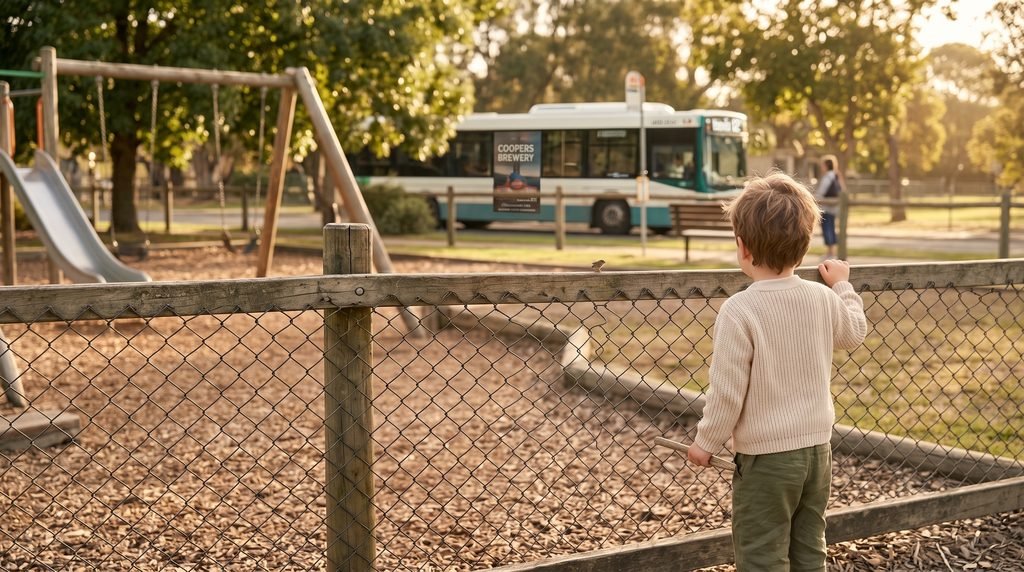
What the book knew, and what the fence knew
I went home that night and did what I always do, which is pull something off the shelf. Attachment. Separation. the Circle of Security. The whole vocabulary was there, and it was all correct. The theory described him accurately. It gave me words for something I had been watching for weeks without seeing.
But no book told me it was 3:40.
Theory can tell you that a small child seeks closeness to the person who keeps them safe. It cannot tell you that this child’s closeness runs to a timetable, and that the timetable is printed on the side of a bus.
That gap — between what the book knows and what the fence knows — is the reason this blog exists.
Children have reasons. We just don’t always have the language
I have never met a two-year-old who did something for no reason. Not once. The reason is often inconvenient, and it is almost always bad news for whatever the adults had planned, but it is there.
The problem is that “there is always a reason” is not, on its own, useful. It is a feeling, and you cannot roster a feeling. You need something to think with. That is what theory is to me — not a rule to apply, but a lens to try. Some lenses bring a child into focus. Some make everything blurrier, and then you put them down and reach for another one.
But a lens with nothing under it is just a piece of glass. I have read chapters that made complete sense right up until Tuesday morning, when Tuesday morning turned out to have thirteen children in it and one of them was biting.
So: the room without theory is guesswork. Theory without the room is decoration. I need both of them in the same place, and I have never had a good place to put them side by side.
This is that place.
A fair objection, which I’m not going to pretend away
Someone reading this could reasonably say: you made that up. You saw a child standing at a fence and gave him a motive, and then felt moved by a story you had written yourself. Maybe he liked the feel of the wire. Maybe he liked watching the cars go by. The kindest version of this objection is that educators tell ourselves stories about children because the stories make us feel less helpless.
I think that’s partly true. But seeing him through a child’s eyes — instead of my own — was what I needed that afternoon. It was the only way I got past a sentence I had already decided was true.
Why I write any of it down
For a long time this all happened and then evaporated. I would notice something at 3:40, drive home, cook dinner, and by the next morning the noticing was gone and only the routine was left. A whole year can pass like that. You get more competent every year and no wiser.
Writing makes me slow. Slow is the only place I have ever caught myself being wrong.
There is still a question underneath all of this that I haven’t answered, though. Why is this the thing I can’t leave alone? Why do I go home from other people’s children and read about other people’s children?
That started long before I had a room of my own. It started in a house where both of my parents were teachers.
Pingback: Why I Started Samy Learning | Part 3: What Samy Means - Samy Learning