
In Part 1 I told you why I write things down. That habit had to come from somewhere — and it turns out no single room raised it.
If you’d asked me, at any point, how I ended up the way I am with children, I’d have told you a tidy story about a staffroom. It’s a good story. It’s also missing at least two other rooms.
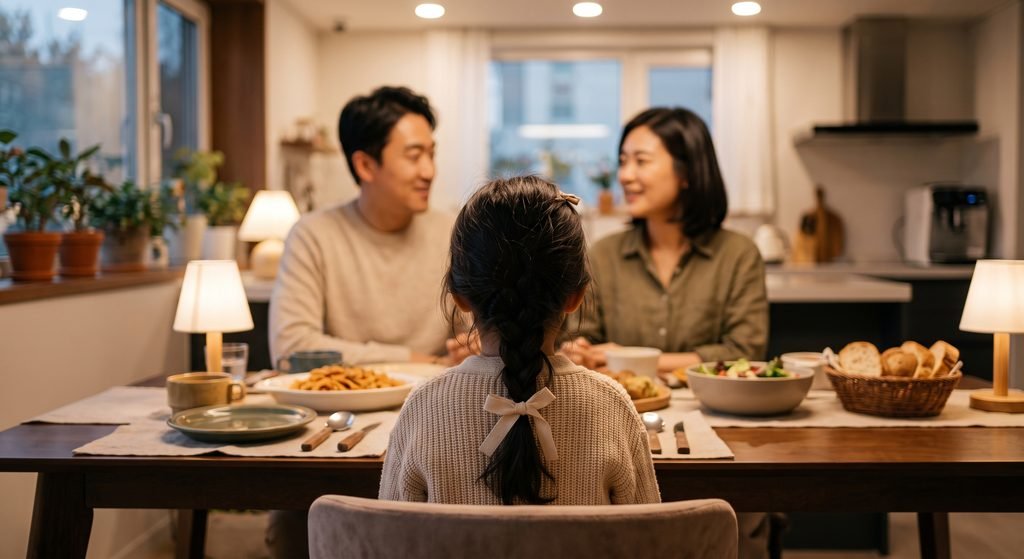
Both of my parents were teachers
I did not choose education the way you choose a career. In our house it wasn’t a job, it was the weather.
Dinner was where other people’s children got discussed — never unkindly, but constantly. A child who had had a hard week. A child who had surprised everyone. Marking on the kitchen table, and the particular quiet that settles over a teacher’s house on a Sunday evening. I knew the mood of a school term long before I knew what a term was.
It took me years to understand how unusual that was. I grew up listening to adults talk about children as people with reasons, rather than as problems with solutions. Nobody sat me down and taught me that. I just heard it every night until it sounded like the way the world was.
Everything I do at work now is a version of a dinner conversation I was too young to join.
And then I went and became the one without the words
After that I moved around, and I want to be careful about how I say this, because the countries are not the point. The stamps in a passport don’t teach anybody anything.
What teaches you is what happens to you when you arrive: you become the person who doesn’t have the language.
I have sat in a classroom understanding perhaps forty percent and nodding at a hundred. Nodding is a survival skill and you get very good at it. I have been spoken to slowly and loudly by people who were being kind. I have had a whole, complete, slightly funny thought in my head, and had it come out of my mouth as four flat words, and watched the other person move on before the real sentence arrived.
I have been described as quiet. I am not quiet. I was quiet in that language.
I am not going to claim this tells me what a two-year-old feels. It doesn’t, and I’d distrust anyone who says it does. But it means I don’t have to imagine one particular thing from scratch — what it is to have the thought and not the sentence, and to be summed up by adults on the strength of the sentence.
The other thing those years gave me is harder to say briefly. There are as many ways to raise a child as there are families, and the differences are not decoration. What counts as polite. Whether a child looks an adult in the eye or looks down out of respect. How much a three-year-old is expected to do alone at a meal, and whether helping them is warmth or interference. I have watched a practice look like a deficit from inside one culture and like excellence from inside another, without the child changing at all.
Once you have seen that happen a few times, you get slower to write “difficulty with” in a report. Which is a good thing, mostly, and Part 1 is about the day it wasn’t quite enough on its own.
TAFE, then the master’s, then the room
I didn’t arrive here by a straight road. TAFE first. Then, few years later, a master’s degree. Then — eventually, and with more nerves than I let on — a room of my own with a fence at the end of the yard.
I mention the order because the order is the whole point. TAFE gave me hands: how to actually be with children all day without either of us falling apart. The master’s gave me a vocabulary and, more usefully, the sense that there was an argument going on and I was allowed into it.
Neither of them taught me 3:40. Only the room taught me that.
People say it takes a village to raise a child. Nobody mentions it can take one to raise a teacher, too. Mine wasn’t quite a village — more a staffroom, a run of classrooms where I was the one without the words, a TAFE campus, and a university. None of them set out to build this. Between them, they did. Which leaves the last question, the one that actually made me sit up buying a domain name at eleven o’clock at night.
What is this blog supposed to be?
And
why is it called Samy?
Pingback: Why I Started Samy Learning | Part 3: What Samy Means - Samy Learning
Pingback: Why I Started Samy Learning | Part 1: The boy at the Fence - Samy Learning