
It could have been any Tuesday.
Somewhere behind me, two chairs scrape across the floor as someone breaks into a run down the middle of the room. Near the block corner, a hand shoots out and swipes at a friend’s arm, because the good red truck just got picked up by someone else. By the shelf, a tower that took ten minutes to build gets pulled apart, piece by piece, before the builder even notices.
Someone is holding the whole basket of felt animals against their chest and will not, absolutely will not, pass a single one over. Somewhere in the middle of all that, a child is crying, and I am walking toward all four moments at once — the way you do, most mornings, in a room full of two- and three-year-olds.
The sentence I kept reaching for
“No running.” “No hitting.” “No snatching.” “Please share.” I could hear myself saying some version of these ten or twenty times before morning tea, and by the end of most days my own voice sounded tired to me, let alone to them. The stranger part was how rarely the behaviour actually changed the moment I said it. A child would pause, look at me, and keep going — as if the sentence had passed straight through without landing on anything.
I started noticing the pattern more than I liked: I was spending most of my morning telling two- and three-year-olds what not to do, and it wasn’t working especially well even by its own measure. There had to be a better sentence than “no.”
A game, not a lecture
I didn’t start with a theory. I started with a hunch — if I wanted them to talk and act differently, I wanted them to feel why, not just be told why. So instead of explaining anything, I turned it into a game at Group Time. Always in the morning, because I’ve come to believe the tone you set at nine o’clock is the tone that runs the whole day.
“Okay, everyone — don’t think about an elephant.” Then I just sat there and waited.
Within about two seconds, someone laughed. “But I’m thinking about the elephant!” Then another, delighted with herself: “I can’t stop thinking about it!” We tried it again with a dinosaur, a pink elephant, a “wobbly jelly” one child invented on the spot — and every single time, the room filled with the exact thing I’d just told them not to think about.
I didn’t explain any theory to a room of two-year-olds — they wouldn’t have sat still for it, and honestly, neither would I. I just asked, “So what happens in your brain when I say ‘don’t’?” And they told me, in their own words, that the “don’t” part disappears and only the elephant is left. They found it themselves, which is exactly why it stuck — to them, and to me.
Our shining brain
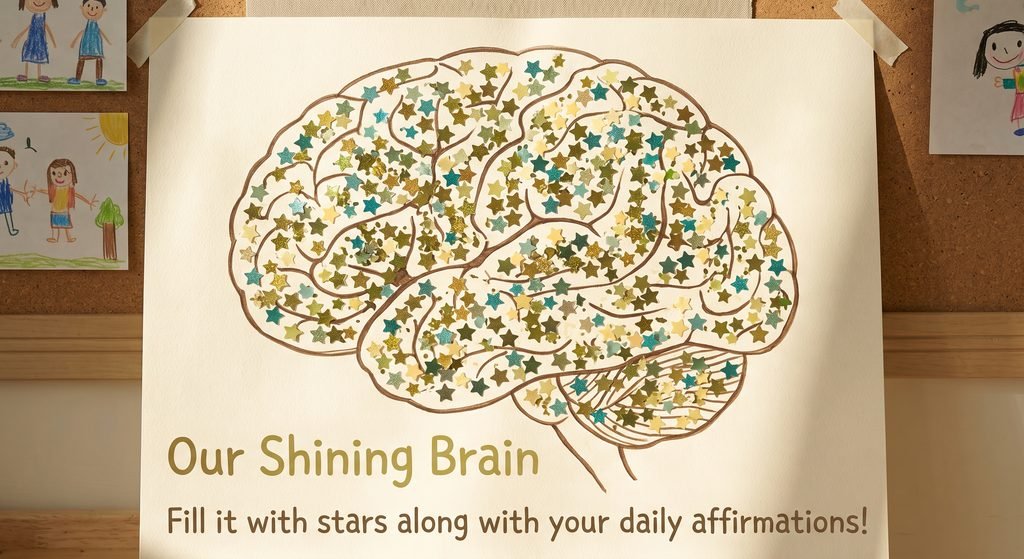
Before any of the weekly strengths began, there was one thing we did every single morning, and it never changed: after our affirmation, we lit up a brain.
I’d shown the class a short, simple video about neurons — nothing complicated, just enough for two- and three-year-olds to watch tiny lights firing across a brain-shaped tangle of lines every time it “learned” something. They were transfixed by it, in the specific way toddlers get transfixed by anything that sparkles. So I drew a picture of a brain with nothing inside it — just the outline, empty and waiting — and told them that was our brain, all of ours, together, and that every time we said one of our affirmations out loud, we got to add one shining star sticker inside it, exactly like the neurons in the video.
That became the real daily ritual, more than the words of the affirmation itself in some ways: say it together, and then someone — some mornings me, most mornings whoever had waited most patiently for a turn — pressed a star onto the brain. Some weeks it filled in slowly. Some weeks, usually right after we’d added a strength they were especially excited about, it filled in fast enough that I had to draw a second one. Every single morning, in the same order: an affirmation, and a brain a little more sparkly than it was the day before.
If you’d like to know which neuron video we used, ask — I’m glad to pass it along.
From there we grew it on purpose: one new affirmation every fortnight, then two a month once the rhythm felt familiar, running all the way through to the end of the year. I didn’t teach every strength the same way, because the strengths themselves aren’t much alike.
Building it slowly, over a whole year
Bravery, one of our positive affirmations, came in through a picture book and a video of a ten-year-old explaining courage in language close enough to theirs that it landed. By the end of that fortnight, I was hearing “I love taking on challenges” come back to me completely unprompted. I even heard a child proudly say, “I tried today’s lunch,” as if trying an unfamiliar food had become their own small act of bravery. These moments had nothing to do with Group Time at all — and that was what made them meaningful.
A Love of Learning got its own song and a little dance we did most mornings, badly at first and better every week.
Kindness didn’t get a book or a song at all; we mostly just talked our way into it, sitting in the circle and naming the kind things we’d actually seen in each other that day, because I wanted them to notice it in one another, not just hear it from me.
Not every attempt landed the first time. Some fortnights the room was unsettled and nothing I tried quite worked, and I had to keep reminding myself that a real classroom doesn’t move in a straight line just because a plan says it should. But across the year the shifts were real — a child who usually said “I don’t know” starting to offer a guess anyway; another who normally hovered at the edge of a group activity, in the middle of it by the second week. Small, slow, and completely worth thirty seconds a fortnight.
The question a colleague asks
Somewhere in the middle of all this, a teacher who’d been watching our Group Time with real interest asked me something I couldn’t answer well the first time: why affirmations — not “is it a nice idea,” but what’s the evidence. She was right to ask. I couldn’t just say something felt good; I needed to be able to explain it to a parent, a director, another teacher, and mean it.
So I spent a weekend reading, starting with the very effect the elephant game had already shown me — the brain’s odd habit of picturing the thing it’s told to avoid, before it can let the thought go (Wegner et al., 1987). I turned what I found into a one-page fact sheet I now keep on hand for exactly that conversation. If you’d ever like a copy, just ask — I’m always happy to share it.
Next: the part you can use tomorrow morning
There’s one more piece I wanted to put down separately, because it’s the part you don’t need any of the rest of this post to use: the full list of “no” phrases I used to lean on, and what I say instead now — turned into something you can print and stick on the wall. That’s Part 2.
Reference
Wegner, D. M., Schneider, D. J., Carter, S. R., & White, T. L. (1987). Paradoxical effects of thought suppression. Journal of Personality and Social Psychology, 53(1), 5–13. https://doi.org/10.1037/0022-3514.53.1.5