
If you’ve read Part 1 and Part 2, you already know where I landed: “wee first or poo later” was never really the right question. The real question is always what does this particular child need, right now, to feel safe enough to try?
So let me show you exactly what that looked like with three children in my own classroom. Same room, same general age group, but three completely different starting points — and three completely different answers.
Child B: the one who was scared of the toilet itself
B didn’t have trouble with the bathroom, or with routines, or with anyone in the room. B was scared of one very specific object: the toilet. The moment it came into view, I’d watch the whole body tense up.
Thinking back to what I talked about in Part 1 — that a bathroom needs to feel like a space a child has some control over, not a space that happens to them — I tried two small, quiet things aimed at handing some of that control back:
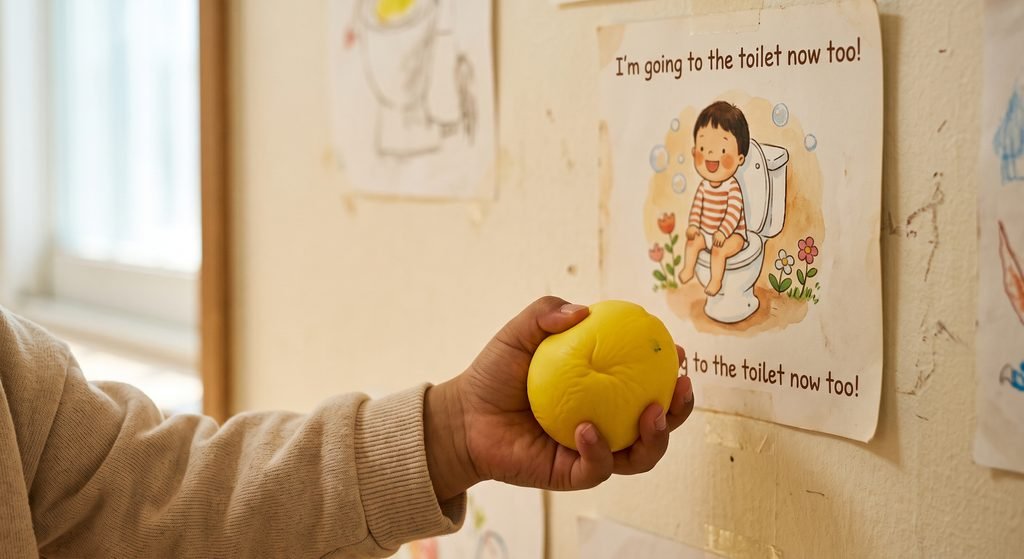
- I gave B a squishy sensory toy — a squeeze ball, a little spinner — to hold while sitting nearby, something B could choose to pick up or put down, on their own terms.
- I printed a page from a picture book about using the toilet and stuck it on the bathroom wall, so every time we walked in, B always knew exactly what was coming — no surprises sprung on a body that already felt out of control near that toilet.
Neither of these was a fear-reduction “technique” so much as an attempt to answer the same question I now ask myself at every toilet trip: does this child feel like they have any say here? Slowly, the tensing-up got shorter. The picture on the wall stopped needing much explanation at all — B started pointing to it for me, which felt like exactly the kind of small, self-directed ownership I was hoping to see. This was very much the “step by step” path I mentioned in Part 2 — small, repeated, predictable wins, stacked one on top of the other, each one handing a little more control back to B, until the fear had nowhere left to sit.
Looking back, this was quietly close to what Skinner called shaping — breaking a big, unreachable goal into small steps, and reinforcing each little bit of progress until the fuller behaviour shows up. I wasn’t running an experiment; I was just following the B’s pace. But the shape of it — small win, then the next small win — was the same.
Child D: the one who couldn’t even get through the door
D’s difficulty started a step earlier — before the toilet was even part of the equation, just walking into the bathroom itself was hard. D was also from a multicultural family, and I didn’t want to just push harder on the toileting skill itself. I wanted to lower the overall stress first — and that meant getting home and classroom properly on the same page, not just me guessing at what would help.
So we did this instead:
- I checked in with the family daily, just briefly, so toileting progress at home and at classroom stayed in sync instead of drifting into two different approaches.
- Home and classroom agreed on the same simple language and cues for toileting, so D wasn’t relearning a completely different set of words and expectations every time they walked through our door.
- At home, D’s dad took the lead on the actual “standing wee” attempts — the real skill practice happened there, on his terms, at his pace.
- At classroom, we turned it into something playful: a target to aim at, so the same idea D was working on at home showed up here as a game rather than a repeat lesson.
This wasn’t guesswork so much as the same partnership idea I described in Part 2 — home and classroom actually talking to each other, instead of each guessing at what the other was doing. Once that daily communication settled into a rhythm and the language lined up on both sides, the actual mechanics — standing, aiming, trying — came surprisingly fast. This one, in a way, was closer to the “all in at once” families I described in Part 2 — once we removed the inconsistency between home and classroom, D didn’t need a slow ramp-up at all, just the right conditions to go for it.
If B’s story leaned toward Skinner, this one leaned toward an older idea (counterconditioning) from Mary Cover Jones, one of the first psychologists to pair something frightening with something a child already enjoyed — turning the bathroom, bit by bit, into a place associated with play rather than pressure. I didn’t plan it as theory in the moment. It just felt like the obvious thing to try.
Child C: the one who just followed their friends
This one still makes me smile. C had been toilet training for a while — but only ever on direct prompting. If I asked, “do you want to go to the toilet?”, they’d go, no problem. Left to their own devices, though, they simply wouldn’t initiate. Toileting was something that happened to them, in response to a question, not something they reached for themselves.
Then they moved up into the Kindy room with the older children.
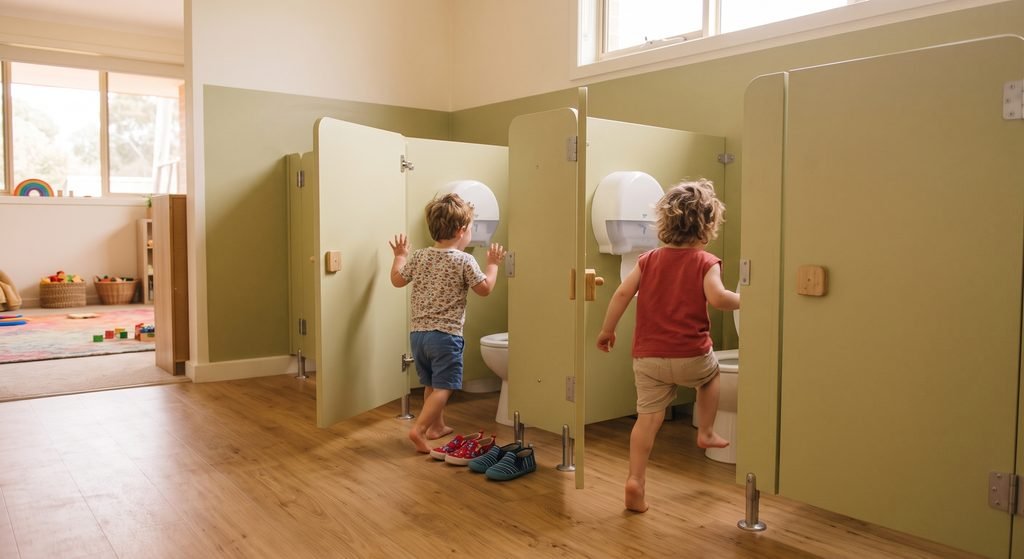
Nothing about our approach changed. I didn’t introduce a new strategy, a new chart, a new reward. What changed was the room around them — older children, a well-worn routine of going to the toilet in twos and threes between activities, without much fuss or announcement at all. And within a couple of weeks, without anyone prompting them, C started quietly getting up and following their friends to the bathroom. No question asked. No reminder needed. They’d simply absorbed it, the way children absorb almost everything, by watching people slightly older than them do it like it was the most normal thing in the world.
If Part 1 had a single thesis, it was that relationships do more of this work than routines ever will — and C is probably the cleanest example of that I have. There was no procedure I could point to, no technique I introduced. It’s less “method” and more just a reminder of something educators know in their bones: peer relationships are one of the most quietly powerful teachers in a room full of young children. Sometimes the missing ingredient isn’t a better prompt from an adult. It’s simply time, and the right company.
What all three stories actually taught me
Neither child needed “wee first” or “poo later.” B needed a sense of control handed back before skill could grow. D needed home and classroom properly aligned before the mechanics could even start — and then went all in, fast. C didn’t need a strategy at all, just the right relationships around them. Three completely different doors, same underlying truth I’ve now said three times across this series: readiness, dignity, and connection come before order, every single time — and sometimes, before “method” too.
If there’s one thing I hope you take from all three parts — the classroom view, the family view, and now these three very real kids — it’s this: the next time someone asks you whether wee first or poo comes later, you have permission to say “honestly, that’s not quite the question I’d be asking.”
Pingback: Wee First, Poo Later? Part 2: The View From the Family Bathroom - Samy Learning