
In Part 1, I told you that from where I sit as an educator, “wee first or poo later” mostly isn’t the right question. But I want to be upfront about something: that’s easy for me to say. I’m not the one doing the 6pm bath-and-bribery routine, or googling “is this normal” at 11pm with a young child finally asleep.
I know because parents tell me. All the time. They come find me at pickup, or catch me for a quiet minute after drop-off, and the questions tumble out in no particular order — is it even the right time to start? What if she just won’t do it? She’s amazing at kindy but won’t try at home — what am I doing wrong? Or the opposite — she’s great at home and refuses at kindy, why?! What face am I supposed to make when there’s an accident? Should we go step by step, or just rip the bandaid off and do everything at once?
None of these questions have anything to do with “wee first or poo later.” And yet they’re the real questions underneath it, every single time. So let’s actually sit with them, one by one.
“Is now even the right time?”
This one comes first, and it comes loaded with doubt. Is my child too young? Too old already? Did I miss the window? And right behind it: what if I start and she just doesn’t follow along at all?
Here’s what I always come back to: there isn’t a magic birthday where readiness switches on. Some children show every sign at two and a half; others aren’t quite there until closer to four. What I said in Part 1 about that push-and-pull between “I can do this myself” and “what if I get it wrong” applies just as much at home as it does at classroom — readiness isn’t really about age, it’s about whether a child currently has enough confidence in their own body to try without it feeling like a test they might fail. Starting “on time” isn’t really a thing — starting when your child is showing you signals of that confidence is. And if the first attempt doesn’t go anywhere, that’s not failure, it’s information. It just means we wait a little longer and try again, calmer, with less riding on it.
“They’re great at Kindy but won’t do it at home” (or the other way around)
This one genuinely confuses parents, and I understand why — it feels contradictory. But it actually makes complete sense once you think about what toileting really asks of a young child: predictability. At the classroom, the routine is the same every single day, the same educators, the same bathroom, the same friends going before and after them. That predictability does a lot of the emotional heavy lifting.
At home, everything is a little looser — different pace, different distractions, maybe a sibling underfoot, maybe just being tired after a long day. So a child doing brilliantly at Kindy and stalling at home isn’t being difficult; they’re responding to two genuinely different environments.
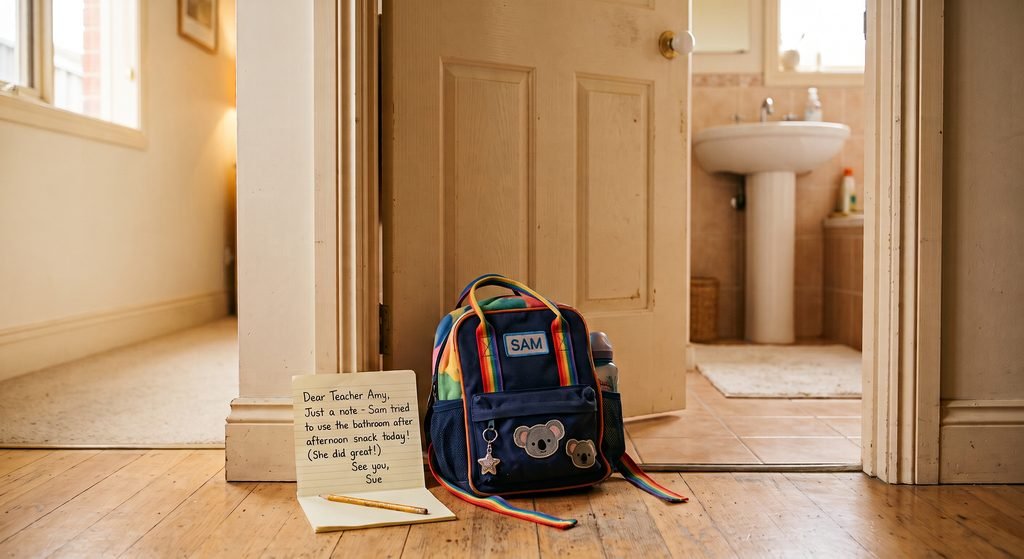
This is actually exactly the gap that partnership between families and educators is meant to close — not handing toileting entirely to one side or the other, but keeping language, expectations and cues lined up across both places (ACECQA, 2018; AGDE, 2022).
In practice, that’s rarely a formal meeting. More often, it’s a short exchange at pickup. I might ask something like:
“Is there a time when she usually does a poo at home? We’ve noticed she sometimes has a poo accident about half an hour after lunch here at kindy.”
And the parent pauses, actually thinks about it properly for the first time, and says, “Actually, yes — she usually goes right after her afternoon snack, every day, like clockwork.”
That’s it. That’s the whole exchange. But suddenly we both have a piece of the puzzle the other one didn’t have. I can start reading her body language a little earlier in the day. They stop being caught off guard by something that, it turns out, was completely predictable all along. This is what partnership between families and educators can look like in practice — not a policy document, just two adults quietly comparing notes about the same child.
And it works the other way too — a child who’s confident and relaxed at home might feel too shy, too unfamiliar, or too unsettled to try the same thing in a room full of other children. Neither direction means something is wrong. It usually just means one environment currently feels safer than the other, and that gap tends to close on its own — faster, in my experience, when home and kindy are actually talking to each other about it.
“What do I do with my face?”
This is the one parents almost never say out loud first, but it’s often what’s weighing on them most. There’s an accident. What expression do you make? Do you sigh? Does your face fall for half a second before you catch it?
Truthfully, this is one of the most important questions on this whole list, because young children read our faces before they process our words. A flash of frustration — even one you didn’t mean, even one you tried to hide — can land as “I did something wrong” rather than “accidents happen while we’re learning.” It’s a small version of the same dignity question I talked about in Part 1: a child needs to feel like this is still their body, their process, something they’re allowed to get wrong without it costing them your approval. My honest advice here is almost embarrassingly simple: practise your neutral-to-warm face in the mirror if you have to. A calm “oops, let’s clean up and try again” delivered with a soft face does more for toileting confidence than almost any technique.
“Step by step, or all in at once?”
And finally, the practical one — do we ease in gradually (wee without a nappy first, keep poo in a nappy a little longer) or go all in together, no nappy at all, from day one?
Honestly? Both work. I’ve watched children succeed brilliantly with the slow, staged approach, building confidence one small win at a time. I’ve also watched children thrive with the “let’s just go for it” approach, where the clarity of no more nappy, this is how we do it now was exactly what they needed. Neither one is the “correct” method waiting to be discovered — it depends entirely on your child’s temperament, and honestly, on your own. Some families need the gentler ramp-up to keep everyone’s nerves intact. Others find that half-measures actually create more confusion, and a clean, confident switch works better.
So — which one is right for your family?
If there’s one thing I hope lands from this list, it’s that none of these worries mean you’re doing it wrong. They mean you’re paying close attention, which is exactly what this whole process asks of you. And just like I said in Part 1 from the classroom side — the “right” approach was never really about the method. It’s about staying connected to your child, keeping home and kindy talking to each other, and letting their responses guide the pace.
In Part 3, I’ll show you exactly what I mean — three real children from my own classroom, three completely different starting points and approaches, and how each one found their own way through.
Australian Children’s Education and Care Quality Authority. (2018). National Quality Framework. https://www.acecqa.gov.au/nqf/national-quality-standard
Australian Government Department of Education. (2022). Belonging, being & becoming: The early years learning framework for Australia (V2.0). Australian Government Department of Education for the Ministerial Council.
Pingback: Wee First, Poo Later? Part 3: Three Children, Three Very Different Doors Into the Toilet - Samy Learning
Pingback: Wee First, Poo Later? Part 1: What I See From the Classroom Chair - Samy Learning