
A song that worked like magic, until it didn’t. This is the story of one group time song, and the five habits it taught me: Why, Try, Watch, Write and Grow.
“Sit on the mat and clap! Sit on the mat and clap…”
For the first few days, it worked like magic. I pressed play, the song filled the room, and one by one, little bodies drifted towards the mat. I remember thinking, Well, that was easy.
Then, slowly, it stopped working.
The song still played. The blocks kept clattering. A few children sat down, but most of them didn’t even look up. The song hadn’t changed at all. To the children, though, it had become what every song becomes when nothing happens around it: background music.
I stood there with the speaker in my hand and thought, Now what?
That question is where this series begins.
What I changed
I put the speaker away and sang the song myself, loudly. I swapped the ordinary clap for my own silly one. When we got to “clap on your…”, I started naming body parts, which happened to be our topic at the time.
Then I started getting it wrong on purpose. I’d sing “knees” and clap my head. The children burst out laughing and corrected me. And the children who weren’t on the mat turned around to see what was so funny.
Within days, something shifted. As soon as they heard my voice, children sat down and waited to see where we’d clap next. Some started calling out their own ideas: “Clap your tummy!”
These days, calling children to group time is one of the easiest parts of my day. The only casualty is my voice, which is a little hoarse by Friday.
The song never changed. I did.
When I looked back at how I got from that speaker to a full, laughing mat, I noticed something. It wasn’t luck, and it wasn’t a clever resource. I had gone through the same five steps that sit behind every activity that has worked in my room, and every one that has flopped.
I think of them as a teacher’s starter kit:
Why → Try → Watch → Write → Grow
This series walks through them one at a time.
Part 1. Why: Know your reason
Why a song, and not just calling names? And do we really need theory before we start?
Part 2. Try: Do it, even if it might not work
Pressing play was a try. So was putting the speaker away. What makes a try worth trying?
Part 3. Watch: See what really happens
The flat moment when my song became background noise turned out to be the most useful thing I saw all month. Here’s what I was watching for.
Part 4. Write: Keep the reflection
“It worked eventually” is a lucky day, not a lesson. How writing it down turns one into the other.
Part 5. Grow: Let experience stretch the learning
How a song I once used just to get children to sit down became a drum lesson months later.
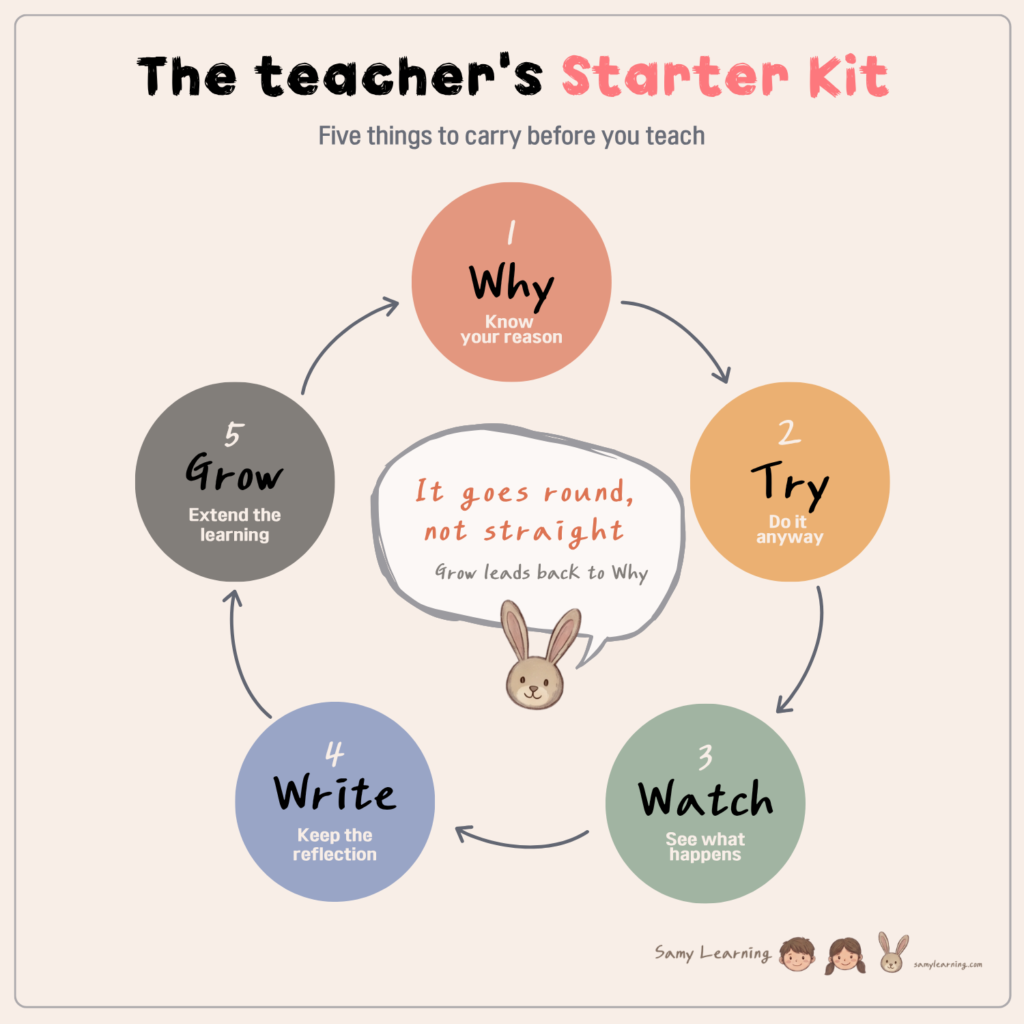
It goes round, not straight
These five steps aren’t a ladder you climb once. Grow leads back to Why, and each time round, you start from a little further along. That’s why I’m calling it a starter kit, not a checklist.
If you’re a new educator who still hears “Can I… try this?” in your head, or an experienced one whose favourite activity has quietly turned into background music, this series is for you.
We’ll start where everything starts: Why.
Reference
Australian Government Department of Education [AGDE]. (2022). Belonging, being and becoming: The Early Years Learning Framework for Australia (V2.0). Australian Government Department of Education for the Ministerial Council.